
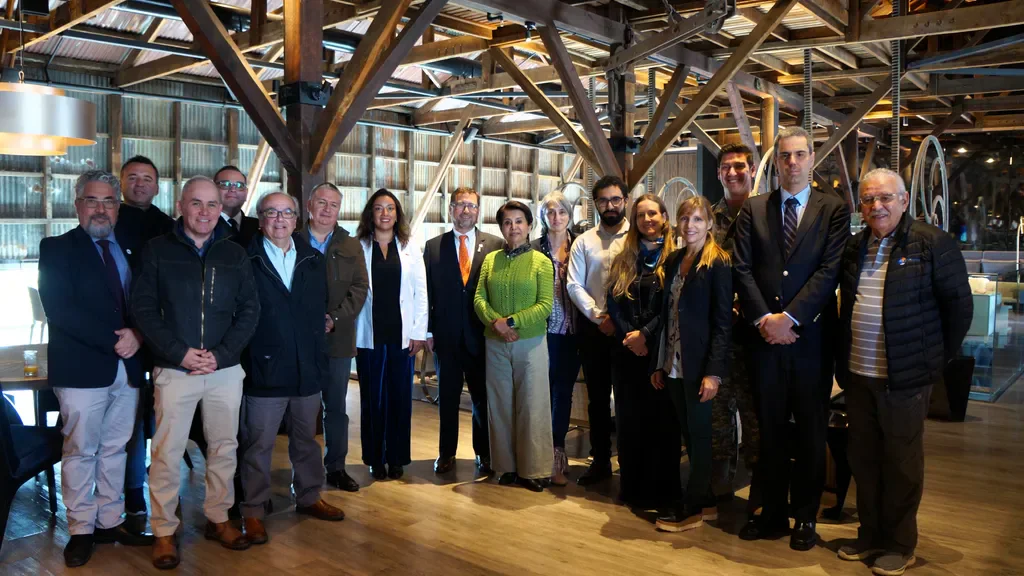
The visit was conducted alongside the Regional Presidential Delegate of Magallanes, Erika Farías, highlighting the importance of the Chilean Antarctic Territory, where the country has maintained a permanent presence for nearly 80 years, consolidating its commitment to science, knowledge, and international collaboration as pillars of national development.
As part of his first working tour through the Magallanes and Chilean Antarctic Region, the Minister of Foreign Affairs, Francisco Pérez Mackenna, visited Explorers House in Punta Arenas. During the event, he emphasized the city’s strategic role as a natural gateway to the Antarctic continent and as a key platform for Chile’s scientific, logistical, and international cooperation development.
The visit was carried out in the company of the Regional Presidential Delegate of Magallanes, Erika Farías, and served to underscore the significance of the Chilean Antarctic Territory. In this region, Chile has maintained a permanent presence for nearly 80 years, reinforcing its commitment to science, knowledge, and international collaboration as fundamental pillars of national progress.
During the day, the Foreign Minister held meetings with members and partners of APAL (Antarctic Punta Arenas Logistics), as well as representatives from the tourism company Antarctica21, who hosted the Minister of State at their visitor center, Explorers House, in the city of Punta Arenas.
Verónica Peragallo, CEO of Antarctica21, highlighted the value of regional collaboration and joint efforts: “Today more than ever, it is vital to have legal certainty in all areas and to consolidate our current institutional framework, because that is how we can continue building and projecting our Region as an attractive development hub for the rest of the world.”
For her part, Presidential Delegate Erika Farías underlined the relevance of such instances for strengthening regional positioning: “We are promoting a strategic vision of Magallanes as a key territory for Chile’s Antarctic projection. Punta Arenas is not only a logistical gateway but also a space for the generation of knowledge, international cooperation, and sustainable development, coordinated between the public sector, private sector, and civil society.”
Furthermore, the meeting allowed for the reaffirmation of the participating institutions’ commitment to education, scientific dissemination, and the generation of knowledge from southern Chile, promoting a future vision based on learning, dialogue, and international cooperation.
With Minister Pérez Mackenna’s visit, a powerful signal is sent regarding the State’s interest in establishing and consolidating Magallanes as a strategic pole for the country’s Antarctic projection. Likewise, it promotes meeting spaces that strengthen the link between science, education, tourism, and sustainable development, from Punta Arenas to the world.